The Fall Facility Safety Audit Checklist: LOTO, Padlocks, and Cabinet Locks
Fall is when most facilities run their safety walkthrough. Before the year-end rush and the winter shutdowns, it's the right time to check what's actually securing your equipment, your energy sources, and your controlled spaces. Here's the checklist we'd run.
A safety audit isn't just a compliance box. It's the walkthrough that catches the worn padlock, the lockout station that's missing half its locks, and the cabinet anyone can open. We put this together the way a facility manager would actually work through it, section by section, so you can print it, walk the floor, and mark what needs replacing before winter.
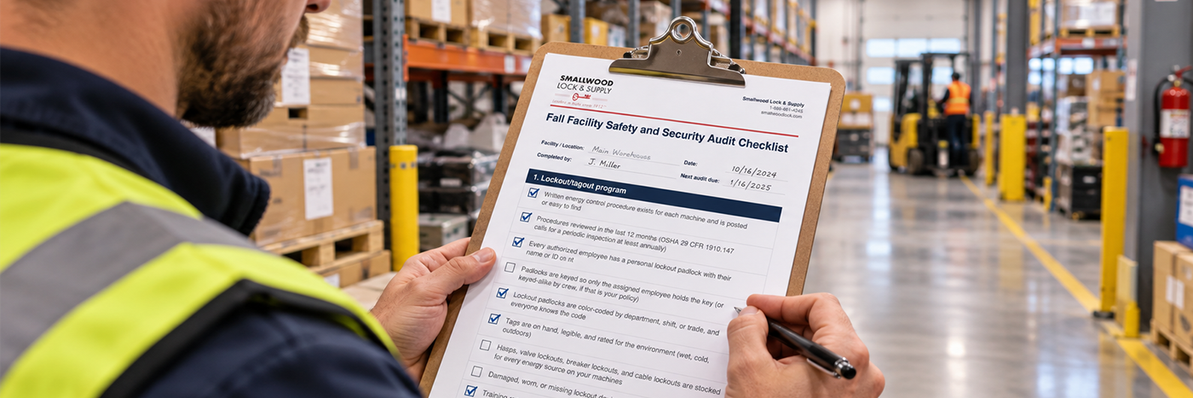
Free download: Fall Facility Safety and Security Audit Checklist
A printable 3-page checklist covering lockout/tagout, key control, padlocks and cabinets, doors and hardware, and electronic locks.
Start with lockout/tagout
Lockout/tagout is where a fall audit earns its keep, because a gap here is a person getting hurt, not just a failed inspection. OSHA's standard (29 CFR 1910.147) requires that energy-isolating devices be locked out during service and maintenance, and that each authorized employee has their own lock and key. Walk every energy source and confirm the hardware is there, rated, and in one piece. For gear to restock, see our safety lockout products.
Check every authorized employee has their own lock
One lock per person, keyed differently, so no one can remove another worker's lock. If people are sharing, or if you're short locks because a few walked off over the year, that's the first thing to fix. Color-coded safety padlocks make it obvious at a glance who's locked out what.
Confirm your lockout devices match your equipment
Breaker lockouts, valve lockouts, plug lockouts, cable lockouts. The device has to fit the energy source it's isolating. An audit is the time to find the odd valve or disconnect that nobody has the right device for, before someone improvises during a real service.
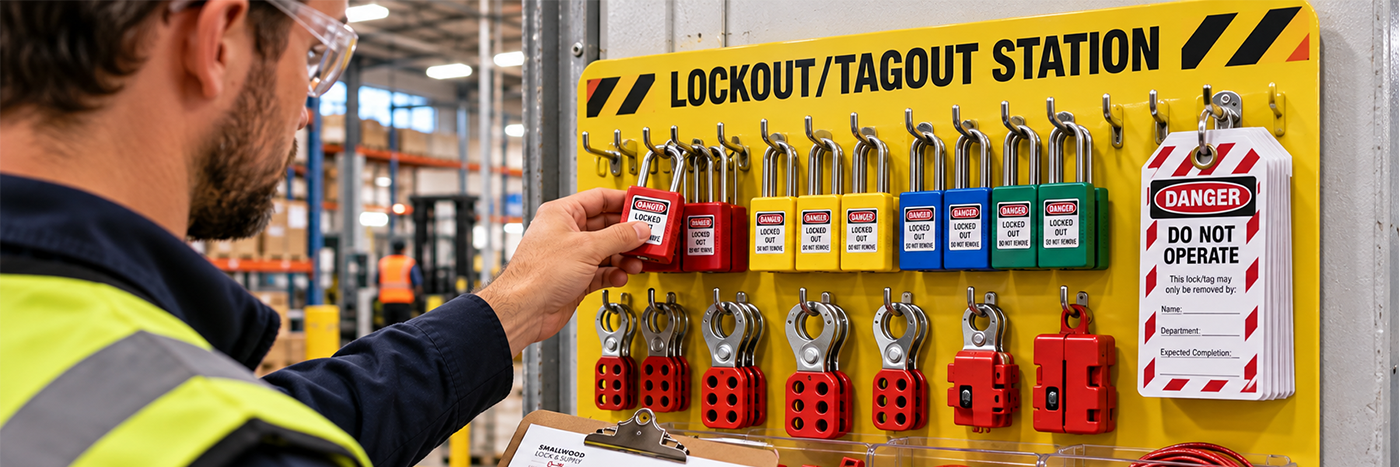
Restock and inspect the lockout stations
Open every station. Are the locks, tags, and devices actually there, or has the station been picked clean through the year? Are the tags legible? A lockout station that's missing its locks isn't a lockout station, it's a sign on the wall.
Then the padlocks doing real work
Outside the LOTO program, padlocks secure gates, sheds, storage, trailers, and equipment yards. These take the weather and the wear, so fall is when you catch the ones that are rusting, sticking, or holding on with a key half your team lost track of.
Look for weather and corrosion damage
A padlock that sticks in October will be frozen shut in January. Check outdoor locks for rust and a stiff shackle. Weatherproof and marine-grade padlocks hold up where standard ones fail, which matters on anything exposed.
Account for every key
If you can't say who holds a key to a gate or a yard, you don't control that access. Re-key or move to keyed-alike sets so one key manages a group of locks and you can actually track who has it. Turnover over the year is exactly why this belongs on a fall audit.
Don't skip the cabinets and cores
The quiet gaps are the cabinets. Chemical storage, records, tools, controlled inventory, server and network gear. These get overlooked because they're not dramatic, but an unlocked chemical cabinet or an open records drawer is both a safety and a security problem.
Secure chemical, tool, and records storage
Anything regulated or hazardous belongs behind a working cabinet lock, not a drawer that rattles open. Confirm the lock is there and functioning, not just present but painted over or broken.
Standardize with interchangeable cores where you can
IC cores let you re-key a whole facility fast when someone leaves or a key goes missing, without pulling and replacing every lock. If your facility is still on a patchwork of one-off cylinders, a fall audit is a good moment to note where standardizing would save you headaches later.
The short version
If you want the one-pass list to walk the floor with, here it is:
- One keyed-different safety padlock per authorized employee, no sharing.
- Lockout devices that match every energy source (breaker, valve, plug, cable).
- Lockout stations restocked, tags legible, nothing picked clean.
- Outdoor padlocks checked for rust and stiff shackles, swapped for weatherproof where exposed.
- Every key accounted for, re-key or keyed-alike where you can't track access.
- Chemical, tool, and records cabinets locked and functioning.
- IC cores noted where standardizing would speed up future re-keys.
Work through it once and you'll know exactly what to reorder before winter, which is the whole point of doing it in the fall. Want it on paper? Download the printable checklist.
Frequently asked questions
How often should a facility run a safety audit?
At least annually, with many facilities doing a fuller walkthrough in the fall before winter shutdowns and a lighter check in spring. OSHA also requires a periodic inspection of lockout/tagout procedures at least once a year.
Does OSHA require a lock for every employee?
For lockout/tagout, yes. Each authorized employee servicing equipment needs their own lock and key so their lockout can't be removed by anyone else. That's why keyed-different safety padlocks, often color-coded, are standard for LOTO programs.
What's the difference between a safety padlock and a regular padlock?
Safety (LOTO) padlocks are non-conductive or specifically rated for lockout use, come keyed different by default, and are usually brightly colored so a locked-out energy source is obvious. Regular padlocks are for general security and are often keyed alike.
Can one key work across our facility's locks?
For general security locks, yes. Keyed-alike sets let one key open a group of locks, and interchangeable cores let you re-key quickly when access changes. LOTO locks are the exception, those stay keyed different on purpose.
Running your fall audit? Browse our safety lockout/tagout, padlocks, and cabinet and cam locks, or call us at 1-888-881-4245 and our team will help you spec exactly what your facility needs.
Family-owned and supplying security professionals since 1912.
Recent Posts
-

The Fall Facility Safety Audit Checklist: LOTO, Padlocks, and Cabinet Locks
Fall is when most facilities run their safety walkthrough. Before the year-end rush and the winter …Oct 7th 2026 -

Your Front Door Is Your First Firewall: Physical Security in a Digital World
You've got a password manager. Two-factor on everything. Maybe a VPN. But the server humming in you …Oct 1st 2026 -
Is Your Lockout/Tagout Program Up to Code? Here’s What You Need to Know in 2026
Every year, thousands of workers are injured — and hundreds killed — because a machine was not prop …May 14th 2026