Is Your Lockout/Tagout Program Up to Code? Here’s What You Need to Know in 2026

Every year, thousands of workers are injured — and hundreds killed — because a machine was not properly de-energized before someone reached in to fix it. A conveyor belt starts unexpectedly. A hydraulic press cycles while a technician’s hands are inside. A valve releases stored pressure without warning.
These are not freak accidents. They are preventable. And in most cases, a properly implemented Lockout/Tagout (LOTO) program would have stopped every one of them.
If your facility services, maintains, or repairs machinery or equipment, OSHA requires you to have a LOTO program. Not a suggestion. Not a best practice. A legal requirement. And if your program is outdated, incomplete, or missing the right equipment, you are one inspection away from a very expensive problem.
Here is everything you need to know to make sure your program is current, compliant, and actually protecting your people.
What Is Lockout/Tagout and Why Does It Exist?
OSHA’s standard for the Control of Hazardous Energy — known as Lockout/Tagout (LOTO) — is codified at 29 CFR 1910.147 for general industry and outlines measures for controlling various types of hazardous energy. The standard establishes the employer’s responsibility to protect workers from hazardous energy releases during the servicing and maintenance of machines and equipment.
In plain terms: before anyone performs maintenance on a machine, that machine must be completely shut down, its energy sources isolated, and physical locks and tags applied to prevent it from being re-energized — accidentally or intentionally — while workers are exposed to its dangerous parts.
OSHA’s six-step LOTO process is credited with saving an estimated 120 lives and preventing 50,000 injuries annually. Those are not abstract statistics. Those are real people going home to their families at the end of the shift because someone made sure the machine’s lock was on.
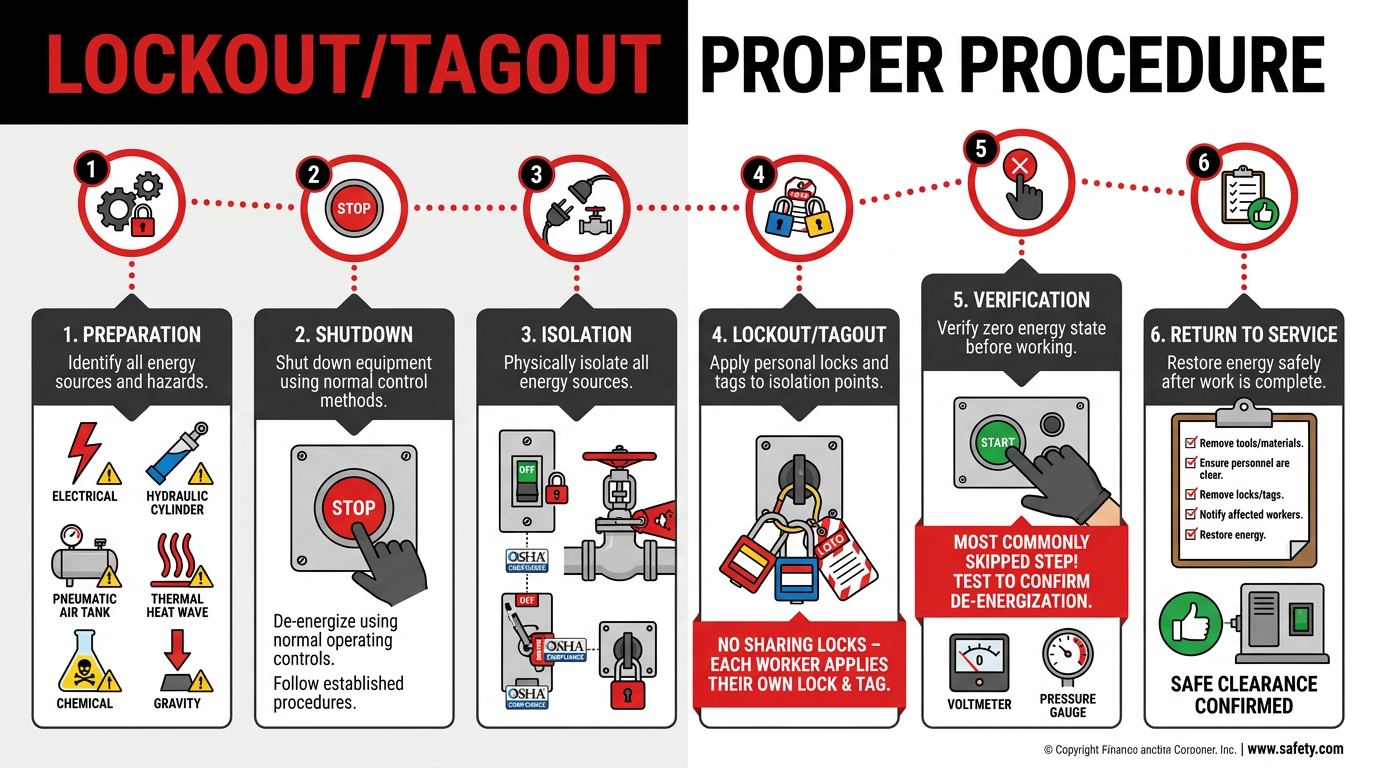
The Six Steps of a Compliant LOTO Procedure
A proper lockout/tagout procedure is not just putting a padlock on a switch. OSHA’s six-step process requires:
| 1 | Preparation — Identify every energy source connected to the equipment: electrical, mechanical, hydraulic, pneumatic, thermal, chemical, and gravitational. |
| 2 | Shutdown — Power down the equipment using its normal operating controls. Do not use emergency stops for routine lockout. |
| 3 | Isolation — Physically operate energy-isolating devices — circuit breakers, disconnect switches, valves — to cut off all energy sources. |
| 4 | Lockout/Tagout Application — Each authorized employee applies their own personal padlock and tagout tag to every energy isolation point. No sharing locks. |
| 5 | Verification — Attempt to restart the machine after locks are applied to confirm it cannot energize. This is the most commonly skipped step — and one of the most frequently cited OSHA violations. |
| 6 | Safe Return to Service — Inspect the work area, confirm all tools are removed, verify all employees are safely clear, then remove devices in proper order. |
How Often Is LOTO Cited by OSHA?
More than you might think. Control of Hazardous Energy (Lockout/Tagout) — standard 1910.147 — ranked #4 on OSHA’s Top 10 most cited standards in FY 2025 with 2,177 total violations.
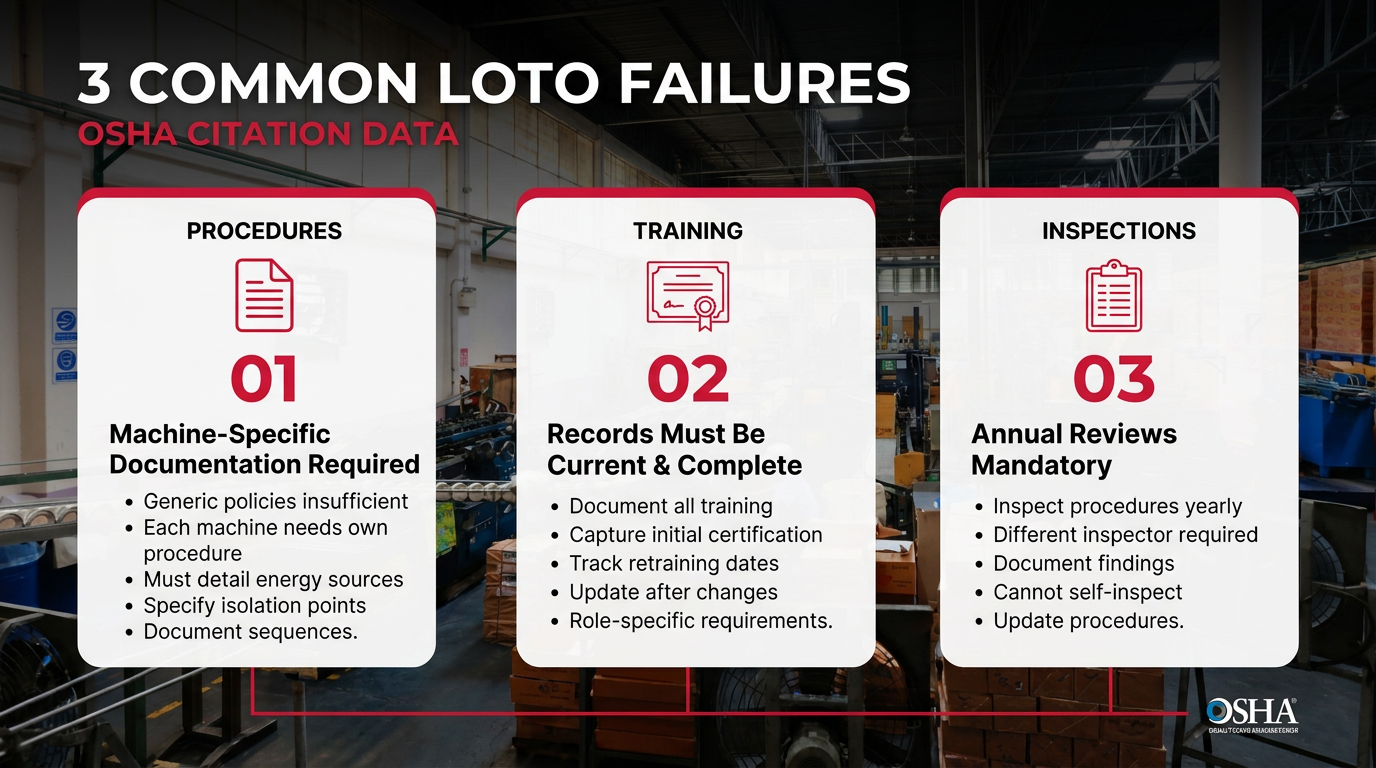
Most violations stem from missing written procedures, inadequate training, and skipped annual inspections — all of which are preventable with a properly implemented energy control program.
The most common reasons facilities get cited are not complicated technical failures. They are administrative gaps — paperwork not done, training not documented, inspections not completed on schedule. Things that a well-organized safety program catches before an OSHA inspector does.
What Are the Penalties for Non-Compliance?
This is where things get serious very quickly.
OSHA Penalty Schedule — 2026
⚠️ Serious Violation: Up to $16,131 per violation
? Willful or Repeat Violation: Up to $161,323 per violation
An employer with 10 machines and no written procedures could face over $165,000 in serious violations alone from a single inspection.
Consider that for a moment. A facility with 10 pieces of equipment and no machine-specific energy control procedures — not an unusual situation in many manufacturing and maintenance environments — could write a check to OSHA for more than $165,000 from a single inspection.
The cost of a complete, properly stocked lockout station with padlocks, hasps, tags, and a group lockout box? A few hundred dollars. The math is not complicated.
What Does a Compliant LOTO Program Actually Require?
Every employer whose workers service or maintain machines where unexpected energization could cause injury must have a written energy control program with machine-specific procedures, employee training, and annual inspections.
The physical equipment requirements include:
Safety Padlocks — Each authorized employee must have their own lock — no sharing. Color-coded padlocks allow facilities to quickly identify which department or individual has a lock applied.
Lockout Hasps — When multiple workers are servicing the same machine simultaneously, a multi-hole hasp allows multiple padlocks to be applied to a single energy isolation point. The machine cannot be re-energized until every employee has removed their personal lock.
Tagout Devices — Warning tags that identify who applied the lockout device, when, and why. Required alongside physical locks in most applications.
Lockout Stations — Centrally located, wall-mounted stations that keep all LOTO equipment organized, visible, and accessible. When equipment is missing from the station, it is immediately obvious.
Group Lockout Boxes — For complex group lockout situations involving multiple workers and multiple energy sources, a group lockout box secures all workers’ keys until the job is complete.
Is Your Equipment Up to the Job?
Even facilities with solid written programs sometimes undercut themselves with inadequate physical equipment. Here is what to audit in your lockout station right now:
- Are all padlocks individually keyed — one key per authorized employee?
- Do you have enough hasps for group lockout situations?
- Are your tagout devices durable, legible, and standardized?
- Are lockout stations fully stocked and visible on the floor?
- Do you have color-coded locks for department identification?
- Are group lockout boxes available for complex multi-energy equipment?
If any of those answers is no — or “I’m not sure” — your program has a gap that an OSHA inspector will find.
Don’t Wait for an Incident to Find Out
The sad reality of LOTO compliance is that most facilities only discover their gaps in one of two ways — an OSHA inspection or a workplace injury. Neither is an acceptable way to learn that your program needs attention.
The good news is that building and maintaining a fully compliant, fully stocked LOTO program is neither complicated nor expensive. The right padlocks, the right stations, the right hasps and tagout kits — all in stock, all ready to ship, all from the brands OSHA compliance officers expect to see on your equipment.
Shop Safety Lockout at Smallwood Lock & Supply
We carry Master Lock, American Lock, and ABUS safety lockout products for manufacturing, maintenance, and industrial facilities — color-coded, master-keyed, and OSHA-compliant — at up to 50% off big-box store pricing.
Because a missing padlock should never be the reason someone gets hurt —
and it should never be the reason you write a six-figure check to OSHA.
Free shipping on orders $350+ | Code: FREESHIP2026 | Same-day shipping on most orders
Sources: OSHA 29 CFR 1910.147 | OSHA FY2025 Top 10 Violations | OSHA 2026 Penalty Schedule | EHS Careers LOTO Compliance Guide
```
Recent Posts
-
Is Your Lockout/Tagout Program Up to Code? Here’s What You Need to Know in 2026
Every year, thousands of workers are injured — and hundreds killed — because a machine was not prop …May 14th 2026 -

The Facility Manager’s Guide to Master Key Systems
Picture this: it’s 6:45 a.m., and your HVAC contractor needs immediate access to the mechanical room …Mar 24th 2026 -
One Priority, Multiple Strategies: Finding the Right Lockout Tagout Program for Your Facility with Smallwood Lock & Supply
At Smallwood Lock & Supply, we understand that workplace safety is paramount. Developing an effectiv …May 13th 2025