
The Facility Manager’s Guide to Master Key Systems
Picture this: it’s 6:45 a.m., and your HVAC contractor needs immediate access to the mechanical room. Your head of maintenance is out sick, and the classroom wing is about to be unlocked for early arrivals. You’re standing at the front door of your facility, juggling a ring of 30 keys, squinting at tiny engraved numbers in the dark, trying to remember which one opens which door.
If that scenario sounds familiar, your building is overdue for a master key system.
Whether you manage a school district, a healthcare campus, a multifamily property, or a commercial office building, a properly designed master key system is one of the most impactful investments you can make in your facility’s security and day-to-day efficiency. At Smallwood Lock & Supply, we’ve been helping Kansas City and Midwest facility managers design and supply these systems since 1912. This guide will walk you through everything you need to know — from the basics of how master key systems work, to choosing the right hardware, to maintaining your system for the long haul.
What Is a Master Key System, and How Does It Work?
At its core, a master key system is a hierarchy of keys and locks in which different keys can open different combinations of locks, while each lock still has its own unique key. The technology that makes this possible is the pin tumbler lock.
A standard pin tumbler lock consists of a series of pin stacks, each comprising a key pin (bottom) and a driver pin (top). When the correct key is inserted, the pins align at what’s called the “shear line,” allowing the cylinder to rotate and the lock to open. To create a master key capability, a locksmith adds a small master wafer between the key pin and driver pin in each stack. This creates a second shear line within each pin stack — meaning two different key cuts can now open the same lock: the individual change key, and the master key.
The result is a layered access system that gives the right people access to the right doors — and keeps everyone else out.
The Key Hierarchy: Understanding the Levels
One of the first things to understand about master key systems is that they operate on levels of access, from the most restricted at the bottom to the broadest at the top. Here’s how the hierarchy typically works:
Change Keys are the individual keys distributed to employees or occupants. Each change key opens one specific lock — or a group of locks that have been “keyed alike.” For example, in a school building, a teacher’s key might open their classroom, their supply closet, and the staff restroom, but nothing else.
Sub-Master Keys sit one level above change keys and open a defined group of locks. In a hospital setting, a sub-master might give a department supervisor access to every room in their wing, without opening doors in other departments.
Master Keys operate all locks at or below the master key level in the system. In a commercial building, the facilities manager’s master key might open every office, mechanical room, and utility space.
Grand Master Keys span multiple master key systems, making them useful for organizations managing multiple buildings or campuses. A district facilities director, for example, might carry a grand master key that works at every school in the district, while each principal carries a master key that only works within their building.
Great Grand Master Keys sit at the very top of the pyramid and are typically reserved for the highest-level organizational access — think a property management company that oversees an entire portfolio of buildings. These should be issued to as few people as possible.
The fewer levels in your master key system, the more secure it is. Each additional level introduces more “false set” positions in the lock mechanism, marginally increasing the technical complexity of the cylinder. This is why choosing high-quality locks at each level matters — and it’s why the brands you select make a meaningful difference.
Why Every Facility Manager Should Have One
The operational case for a master key system goes far beyond convenience. Here’s what a well-designed system actually delivers:
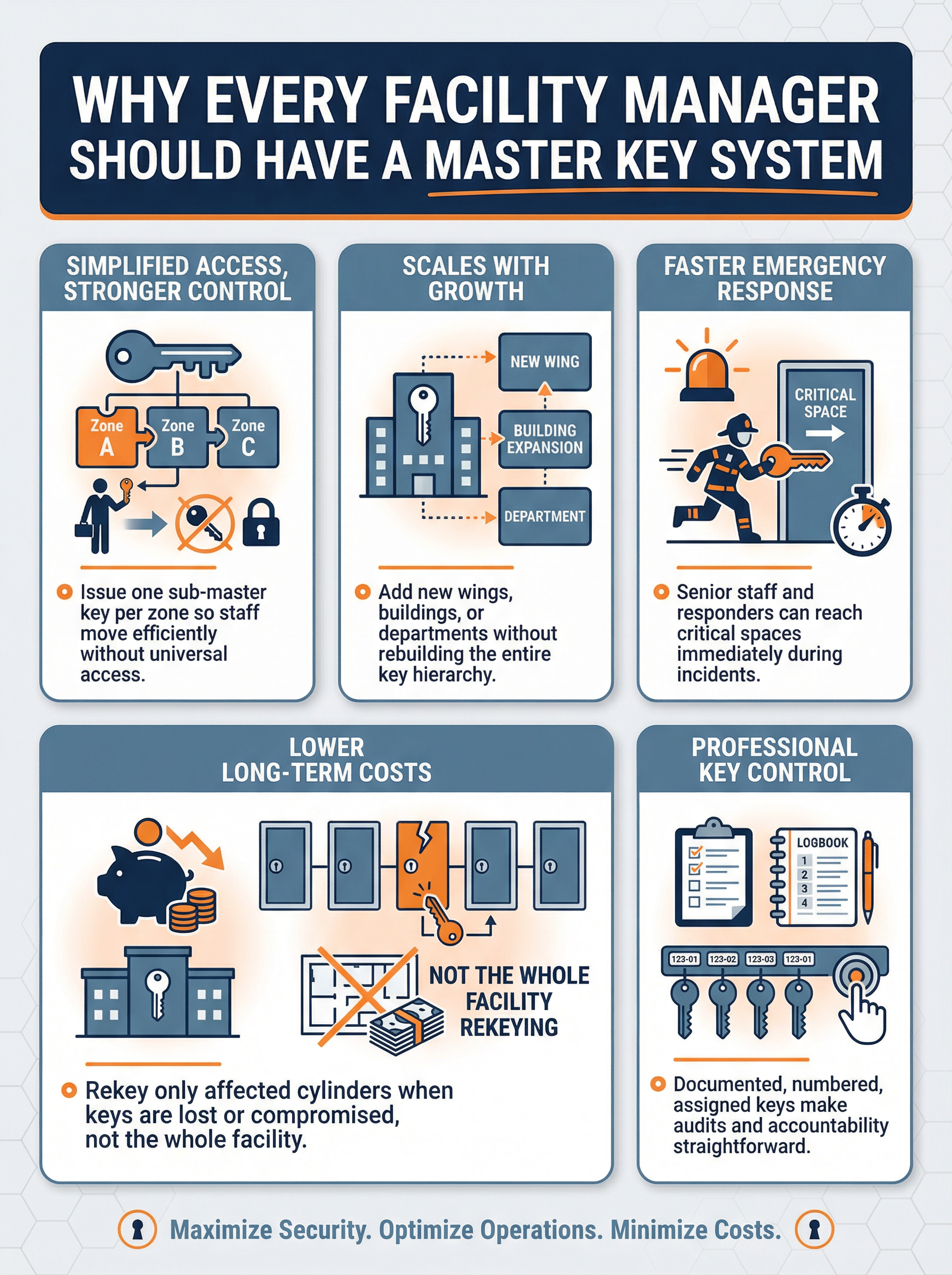
Simplified access without sacrificing control. Instead of issuing a different key for every door a maintenance worker needs, you issue one sub-master key that covers their zone. Your cleaning crew can move through the building efficiently. Your managers can respond to emergencies without having to hunt for the right key. Access is streamlined, but it’s still controlled — not everyone has access to everything.
Scalability as your facility grows. A thoughtfully designed master key system can grow with you. Adding a new wing, a new building, or a new department doesn’t require scrapping your existing system — it simply means expanding within the hierarchy you’ve already established. This is why planning your system with future growth in mind is so critical.
Faster emergency response. In a medical emergency, a fire, or a security incident, the last thing you want is someone fumbling with keys. A master key system means your emergency responders and senior staff have immediate access to any space they need.
Reduced costs over time. Replacing lost or compromised keys in a master key system — especially one using restricted keyways — is far cheaper than rekeying an entire facility. When an employee leaves, or a key goes missing, you rekey only the specific cylinders at risk, not everything.
Professional key control. A master key system enforces accountability. Every key is documented, numbered, and assigned to a specific person. Audits are straightforward. Lost key procedures are clear. It signals to employees, tenants, and visitors alike that your facility is professionally managed.
Choosing the Right Hardware: Brands That Deliver
Not all locks are created equal — especially when it comes to master key applications. At Smallwood Lock & Supply, we carry the industry’s most trusted brands for commercial and institutional master key systems. Here’s what you should know about each.
Master Lock: Proven Reliability at Scale
Master Lock has been the backbone of commercial security systems for over a century, and for good reason. Their Pro Series® and commercial padlock lines are specifically engineered for master key applications, offering what the company calls reserved keyways. This system limits the distribution of key blanks to authorized customers, preventing unauthorized duplication.
Master Lock’s Edge® Key Control system is particularly valuable for facility managers who need tight key control without moving to a fully electronic system. Edge® uses patented keyways that can’t be copied at standard hardware stores or with box cutters, adding a critical layer of protection. The system is available across Master Lock and American Lock padlock lines, making it an affordable upgrade for facilities that want key duplication control without the cost of high-security cylinders throughout.
For facilities with multiple exterior padlock applications — utility enclosures, storage units, chained gates, dumpster corrals — Master Lock’s commercial laminated steel padlocks can be ordered as part of your master key system through Master Lock’s Charting Service, which maintains a complete record of progressive key codes assigned to your padlocks. This means every future padlock you add to your facility can be keyed into your existing system.
For outdoor and corrosive environments — think loading docks, outdoor storage, utility yards — Master Lock’s Magnum series, with boron-carbide shackles and stainless steel bodies, delivers industrial-grade durability without sacrificing master key compatibility.

American Lock: The Industrial Standard
American Lock, a sister brand to Master Lock under Fortune Brands, is the go-to choice for heavy-duty industrial environments. If your facility includes manufacturing areas, maintenance bays, loading docks, or any application demanding maximum abuse resistance, American Lock is where you turn.
American Lock padlocks feature solid steel bodies, hardened steel shackles, and 6-pin cylinders that provide exceptional resistance to both physical attack and unwanted key interchange — a critical concern in master key systems where cylinder tolerances directly affect security. Like Master Lock, American Lock padlocks can be ordered in Keyed Alike, Master Keyed, or through the Edge® Key Control system for restricted duplication.
For facility managers overseeing industrial campuses, warehouses, or utility infrastructure, American Lock provides the physical durability to match the organizational structure of your master key system. A maintenance supervisor’s sub-master key can open every American Lock padlock on a loading dock, every gate in a yard, and every equipment enclosure in a mechanical room — while operators’ individual keys only open the specific equipment they’re authorized to access.
ABUS: Precision Engineering for Demanding Applications
Germany’s ABUS is a favorite among security professionals for applications where precision engineering and high-security performance matter most. ABUS padlocks are renowned for tight tolerances, excellent resistance to manipulation, and a design philosophy that prioritizes long-term reliability even in challenging environments.
The ABUS 24IB/50 Weatherproof DISKUS® Padlock — available at Smallwood Lock — is a standout example. The DISKUS® design uses a rounded, disc-shaped body with a protected shackle that sits nearly flush against the body, making it extremely resistant to bolt cutters and prying. For exterior doors, utility rooms, and any high-value access point in your master key system, the DISKUS® series combines physical security with master key compatibility.
ABUS’s 72, 74, and 76 series safety and lockout padlocks are also available with controller-key configurations, making them ideal for facilities that need both a safety lockout/tagout program and an integrated master-key system. This is particularly valuable in healthcare and manufacturing environments where OSHA lockout/tagout compliance overlaps with your broader facility access control needs.
Designing Your System: Where to Start
The most common mistake facility managers make with master key systems is treating the hardware as the first decision. It isn’t. The first decision is your access map.
Start with a floor plan and access audit. Walk your facility — or review your blueprints — and map every door, every access point, and every space that requires controlled entry. Identify which spaces are universally accessible, which require departmental access, and which are restricted to senior staff or authorized personnel only.
Define your roles and access levels. Who are the key holders at each level? Maintenance staff, department supervisors, security personnel, administration, and emergency responders all have different access needs. Map these roles to the levels of your key hierarchy before you ever think about which locks to order.
Think about future growth. A master key system that perfectly serves your building today but can’t accommodate a new wing next year is a poor investment. Design expansion into every level of your system from the start. Your locksmith or distributor — like Smallwood Lock — can help you calculate how many key differences are available at each level so you don’t paint yourself into a corner.
Choose restricted keyways. For any serious facility, we strongly recommend restricted or patented keyways. These are key profiles that can only be duplicated by authorized dealers — meaning an employee can’t walk down the street to a hardware store and copy their key. Restricted keyways are the single most cost-effective upgrade you can make to a master key system.
Document everything from Day One. Create a key issuance log that tracks who has which key, when it was issued, and what level of access it provides. Update it every time a key is issued, returned, or reassigned. Many facilities now use key management software, but even a well-maintained spreadsheet is far better than no documentation at all.
Maintaining Your Master Key System Over Time
A master key system is not a set-it-and-forget-it investment. It requires ongoing management to remain secure and functional.
Conduct annual audits. At least once a year, verify that every key in your system is accounted for. Compare your issuance log against your current staff roster. If keys are unaccounted for, take immediate action — rekey the cylinders that those keys could access.
Establish a clear return policy for departing staff. Key return should be a standard part of your employee offboarding checklist, no different from returning a laptop or an ID badge. When a master-level key is not returned, rekey immediately.
Rekey after security incidents. If any key at the master or sub-master level is lost, stolen, or potentially compromised, rekey the affected cylinders without delay. The cost of rekeying specific cylinders is always less than the liability of a security breach.
Schedule periodic hardware inspections. Cylinders wear over time. A worn cylinder in a master key system can create unintended key interchange — where a key opens a lock it wasn’t designed to open. Have a locksmith inspect and service your cylinders every few years, or sooner in high-traffic environments.
Ready to Get Started?
Designing a master key system is one of the most important security decisions a facility manager makes. Done right, it simplifies your operations, strengthens your security posture, and serves your facility reliably for years or decades. Done wrong — or with cheap hardware that can’t hold tolerance — it creates vulnerabilities that are expensive to fix.
At Smallwood Lock & Supply, we’ve been supplying and supporting master key systems for schools, hospitals, commercial buildings, and industrial facilities across Kansas City and the Midwest since 1912. We carry the full lines of Master Lock, American Lock, and ABUS, along with the locksmith tools and key machines to service and expand your system over time.
Whether you’re designing a master key system from scratch, expanding an existing one, or replacing aging hardware that’s no longer performing, our team is here to help. We offer same-day shipping on most orders and the deep product expertise that comes from over a century in the business.
Contact us today at 888-881-4245 or visit smallwoodlock.com to discuss your facility’s master key needs. Stop paying retail for security — and start getting it right.
Smallwood Lock & Supply | 120 Abbie Ave, Kansas City, KS 66103 | smallwoodlock.com | Leaders in Locks Since 1912
Recent Posts
-

The Facility Manager’s Guide to Master Key Systems
Picture this: it’s 6:45 a.m., and your HVAC contractor needs immediate access to the mechanical room …Mar 24th 2026 -
One Priority, Multiple Strategies: Finding the Right Lockout Tagout Program for Your Facility with Smallwood Lock & Supply
At Smallwood Lock & Supply, we understand that workplace safety is paramount. Developing an effectiv …May 13th 2025 -

Beat the Business Heat: Safeguarding Your Commercial Locks and Door Hardware This Summer
As temperatures soar, businesses must know that the scorching summer heat can wreak havoc on your co …Jun 20th 2024